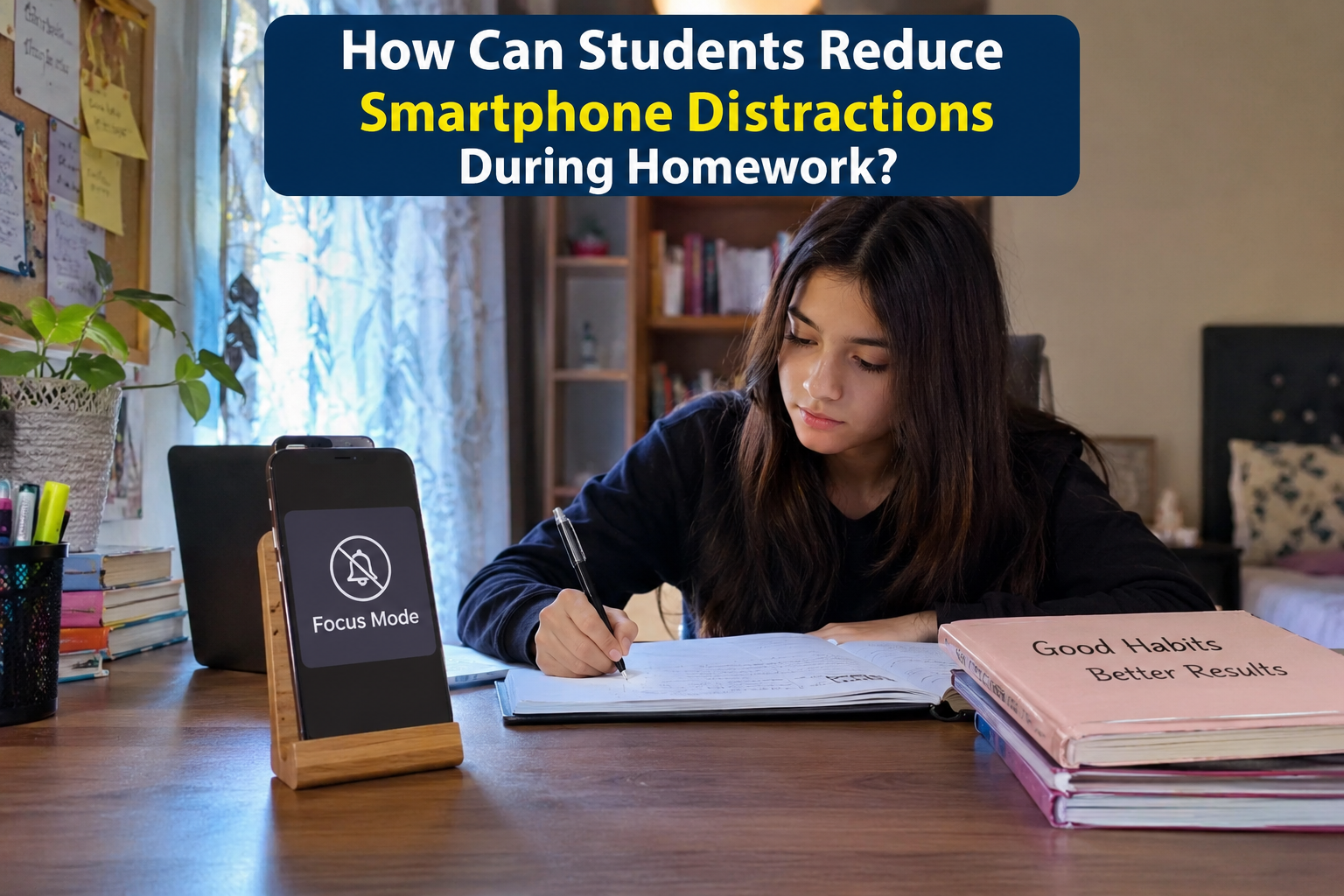
Smartphones have become an important part of everyday life. Students use them to communicate with friends, search for information, watch educational videos, and complete different school activities. Although smartphones offer many useful features, they can also create serious distractions during homework. A simple notification, social media message, or interesting video can easily interrupt concentration and make homework take longer than necessary.
Many students sit down to complete their assignments with good intentions. However, after a few minutes, they pick up their phones to check a message or browse social media. What begins as a short break sometimes turns into thirty minutes of unnecessary scrolling. As a result, students lose valuable study time and struggle to finish their assignments.
Learning how to reduce smartphone distractions during homework is an important step toward developing better study habits. Students do not need to stop using smartphones completely. Instead, they should understand when technology is helpful and when it becomes an obstacle to learning.
This article explains practical ways students can control smartphone use, improve concentration, manage homework time, and create a more productive study routine.
Why Do Smartphones Distract Students During Homework?
Smartphones are designed to provide quick access to entertainment, communication, and information. Social media applications, games, videos, and messaging platforms continuously offer new content that attracts attention.
When students receive notifications during homework, they often feel tempted to check their phones immediately. Even when the notification is not important, it can interrupt their thinking.
For example, a student solving a mathematics problem may receive a message from a friend. After reading the message, the student opens another application and begins watching videos. When the student finally returns to the mathematics problem, it may take additional time to remember the previous steps.
Frequent interruptions make it difficult to maintain concentration. They can also affect the quality of homework because students may rush through assignments to return to their phones.
Understanding these distractions is the first step toward controlling them.
1. Keep Your Smartphone Away From Your Study Table
One of the simplest ways to reduce smartphone distractions during homework is to keep the phone away from the study area.
When a smartphone remains on the table, students may feel tempted to check it repeatedly, even when there are no notifications. Keeping the device within easy reach makes unnecessary phone use more convenient.
A better approach is to place the smartphone in another room, inside a drawer, or somewhere that is not immediately accessible.
Students who need their phones for emergencies can keep them nearby but outside their direct line of sight.
This small change helps create a physical boundary between homework and entertainment. It also encourages students to pay greater attention to books, notebooks, and assignments.
2. Turn Off Unnecessary Notifications
Notifications are among the most common causes of smartphone distractions while studying.
Messages, social media updates, gaming alerts, and application reminders can interrupt concentration several times during a single homework session.
Students can reduce these interruptions by turning off unnecessary notifications before beginning their assignments.
Most smartphones provide options to silence selected applications or activate a focus mode.
For example, students can disable notifications from entertainment applications while allowing important calls from family members.
By controlling notifications, students can create a quieter digital environment that supports better concentration.
3. Create a Fixed Homework Schedule
A regular homework schedule helps students develop discipline and reduce unnecessary smartphone use.
When students do not have a clear study routine, they may switch between homework and entertainment throughout the evening.
Setting a specific time for homework creates a predictable daily habit.
For example, a student might complete homework between 5:00 PM and 7:00 PM, depending on school responsibilities and family activities.
During this period, smartphone use should be limited to educational purposes or important communication.
Following a consistent schedule makes it easier to recognize when it is time to study and when entertainment is appropriate.
Over time, this routine can improve time management and help students complete assignments more efficiently.
4. Use Focus Mode or Do Not Disturb Settings
Modern smartphones include useful features that can help students manage digital distractions.
Focus Mode and Do Not Disturb settings allow users to reduce interruptions by limiting notifications and restricting access to selected applications.
Students can activate these features before starting their homework.
For example, entertainment applications can be temporarily restricted while educational tools remain available.
Some smartphones also allow students to create customized study settings.
These settings can automatically silence notifications during selected hours.
Using built in smartphone controls is a practical way to manage technology without completely avoiding it.
Students should explore their device settings and choose options that match their homework needs.
5. Divide Homework Into Smaller Tasks
Large homework assignments sometimes feel difficult or overwhelming. When students become frustrated, they may turn to their smartphones for entertainment.
Dividing homework into smaller tasks can make studying feel more manageable.
For example, instead of planning to complete an entire science chapter at once, a student can divide the work into reading, note taking, answering questions, and reviewing important concepts.
Each completed task creates a sense of progress.
Students can write these tasks in a notebook and mark them as finished.
This approach provides clear direction and reduces the temptation to escape difficult assignments through smartphone use.

6. Take Short and Planned Study Breaks
Studying continuously for long periods can lead to mental tiredness. When students feel exhausted, they may automatically reach for their smartphones.
Taking planned breaks can help students maintain attention.
One practical approach is to study for approximately 25 minutes and then take a five minute break.
However, students should adjust their study periods according to their age, concentration level, and homework difficulty.
During breaks, activities such as stretching, drinking water, or walking around the room may provide better relaxation than scrolling through social media.
Smartphone entertainment can easily extend beyond the planned break.
Therefore, students should choose relaxing activities that make it easier to return to homework.
7. Set Clear Smartphone Usage Rules
Personal rules can help students develop responsible smartphone habits.
These rules should be realistic, simple, and easy to follow.
For example, students may decide that they will not open social media applications until they complete their mathematics and English assignments.
Another useful rule is to check personal messages only after finishing an important homework task.
Students can write their rules on paper and place them near their study table.
Visible reminders encourage consistency and make it easier to resist distractions.
The purpose of these rules is not to punish students for using technology. Instead, they help students understand that entertainment and academic responsibilities require appropriate boundaries.
8. Use Smartphones Only for Educational Purposes
Smartphones can support learning when students use them carefully.
Educational videos, dictionaries, calculators, online libraries, and learning applications can make difficult topics easier to understand.
However, students should clearly identify why they need their phones before opening them.
For example, a student studying English vocabulary may use an online dictionary to check the meaning of unfamiliar words.
After finding the required information, the student should return to the assignment instead of exploring unrelated applications.
Students can also bookmark reliable educational websites to avoid unnecessary browsing.
Using technology with a specific learning purpose helps students benefit from smartphones while reducing distractions.
9. Create a Comfortable Study Environment
The physical study environment plays an important role in concentration.
A noisy room, uncomfortable chair, or cluttered desk can make homework more difficult.
Students should choose a quiet and organized place where they can study without frequent interruptions.
The study table should contain essential materials such as textbooks, notebooks, pencils, and assignment instructions.
Good lighting and comfortable seating also support productive study sessions.
When students have everything they need nearby, they are less likely to use their smartphones as an excuse to interrupt homework.
A dedicated study area can gradually help students associate that location with learning and concentration.
10. Track Daily Smartphone Screen Time
Many smartphones provide screen time reports showing how much time users spend on different applications.
Students can review these reports to understand their daily digital habits.
For example, a student may discover that social media applications consume two hours every evening.
Recognizing this pattern can encourage the student to set a more reasonable usage limit.
Students can begin with small improvements rather than making sudden changes.
They might reduce unnecessary entertainment time by fifteen or twenty minutes each day and use that time for homework or reading.
Tracking progress over several weeks can help students identify which strategies work best.
The goal is to develop awareness and responsible usage rather than eliminate every minute of recreational screen time.
11. Complete Difficult Homework First
Students often delay challenging assignments because they require additional concentration and effort.
During difficult tasks, smartphones can become an attractive source of distraction.
Completing the most demanding homework first may help students avoid this problem.
For example, a student who finds mathematics challenging can begin with mathematics while feeling mentally fresh.
After completing the difficult assignment, the student can move to easier subjects.
This strategy may reduce stress because the most demanding work is already finished.
It also encourages students to develop confidence in handling challenging academic responsibilities without relying on entertainment as an escape.
12. Ask Family Members for Support
Family support can make it easier for students to develop healthier smartphone habits.
Parents and other family members can help by encouraging regular homework schedules and providing a suitable study environment.
For younger students, parents may establish reasonable smartphone rules during homework hours.
Older students can discuss their study goals with family members and request fewer unnecessary interruptions.
Families should also recognize that smartphones may be needed for educational activities or important communication.
Open communication helps create balanced expectations.
Instead of focusing only on restrictions, families can encourage students to understand the benefits of responsible technology use.
13. Reward Yourself After Completing Homework
Small rewards can make homework routines more enjoyable.
Students can choose a reasonable activity to enjoy after completing their assignments.
For example, watching a favorite video, playing a short game, or chatting with friends can become a reward after homework is finished.
This approach encourages students to separate study time from entertainment time.
However, rewards should not interfere with sleep, family responsibilities, or preparation for the next school day.
Students should also avoid rushing through assignments simply to receive a reward.
The real goal is to complete homework carefully while developing greater self discipline.
14. Practice Self Control Through Small Daily Changes
Reducing smartphone distractions requires patience and consistent effort.
Students who frequently check their phones may find it difficult to change this habit immediately.
Instead of expecting perfect concentration from the beginning, they can make gradual improvements.
For example, a student might begin by completing fifteen minutes of homework without touching the phone.
After becoming comfortable with this routine, the student can increase the distraction free study period.
Small improvements can gradually strengthen self control.
Students should also recognize that occasional distractions are normal.
When they lose focus, the most useful response is to return to the assignment rather than abandon their study plan.
15. Review Homework Progress Every Evening
Reviewing daily progress helps students understand how effectively they manage homework time.
At the end of each study session, students can think about whether they completed their assignments, followed their planned schedule, and avoided unnecessary smartphone use.
They can also identify situations that caused distractions.
For example, if a student repeatedly checks messages during science homework, turning off messaging notifications may help during the next session.
Keeping a simple study journal can make this process easier.
Students can record their homework goals, completed tasks, and areas requiring improvement.
Regular reflection encourages responsibility and helps students build stronger academic habits.
How Can Students Stay Consistent With Smartphone Limits?
Consistency is more important than following strict rules for only one or two days.
Students should begin with realistic goals that fit their daily responsibilities.
A useful approach is to establish a repeatable routine that includes homework, rest, physical activity, family time, and reasonable smartphone entertainment.
Students should also remember that technology itself is not the problem. The main challenge is learning how to control when and why it is used.
By developing clear priorities and practicing responsible digital habits, students can gradually become more independent learners.
Frequently Asked Questions
Should Students Completely Avoid Smartphones During Homework?
Students do not need to avoid smartphones completely. They can use them for educational research, learning applications, and important communication. However, recreational activities should be limited during homework sessions.
Does Turning Off Notifications Improve Concentration?
Turning off unnecessary notifications can reduce interruptions and make it easier to focus on assignments. Students should still allow essential communication when necessary.
How Long Should Students Study Without Checking Their Phones?
There is no single study period that works for everyone. Some students may begin with fifteen or twenty minutes, while others can concentrate for longer periods. The best approach is to choose a manageable period and increase it gradually.
What Should Students Do When They Feel Tempted to Check Their Phones?
Students can remind themselves of their current homework goal, move the phone farther away, and continue working until the next planned break. Practicing this response regularly can strengthen self control.
Conclusion
Learning how to reduce smartphone distractions during homework is an essential skill for students who want to improve concentration, manage time effectively, and develop productive study habits.
Simple strategies such as keeping smartphones away from study tables, disabling unnecessary notifications, following regular homework schedules, and using focus settings can make a meaningful difference.
Students can also benefit from dividing assignments into smaller tasks, taking planned breaks, monitoring screen time, and asking family members for support.
Most importantly, reducing smartphone distractions does not mean avoiding technology entirely. It means using smartphones thoughtfully and understanding the difference between educational activities and unnecessary entertainment.
With patience, realistic goals, and consistent daily practice, students can develop healthier digital habits and complete their homework with greater confidence, attention, and independence.