
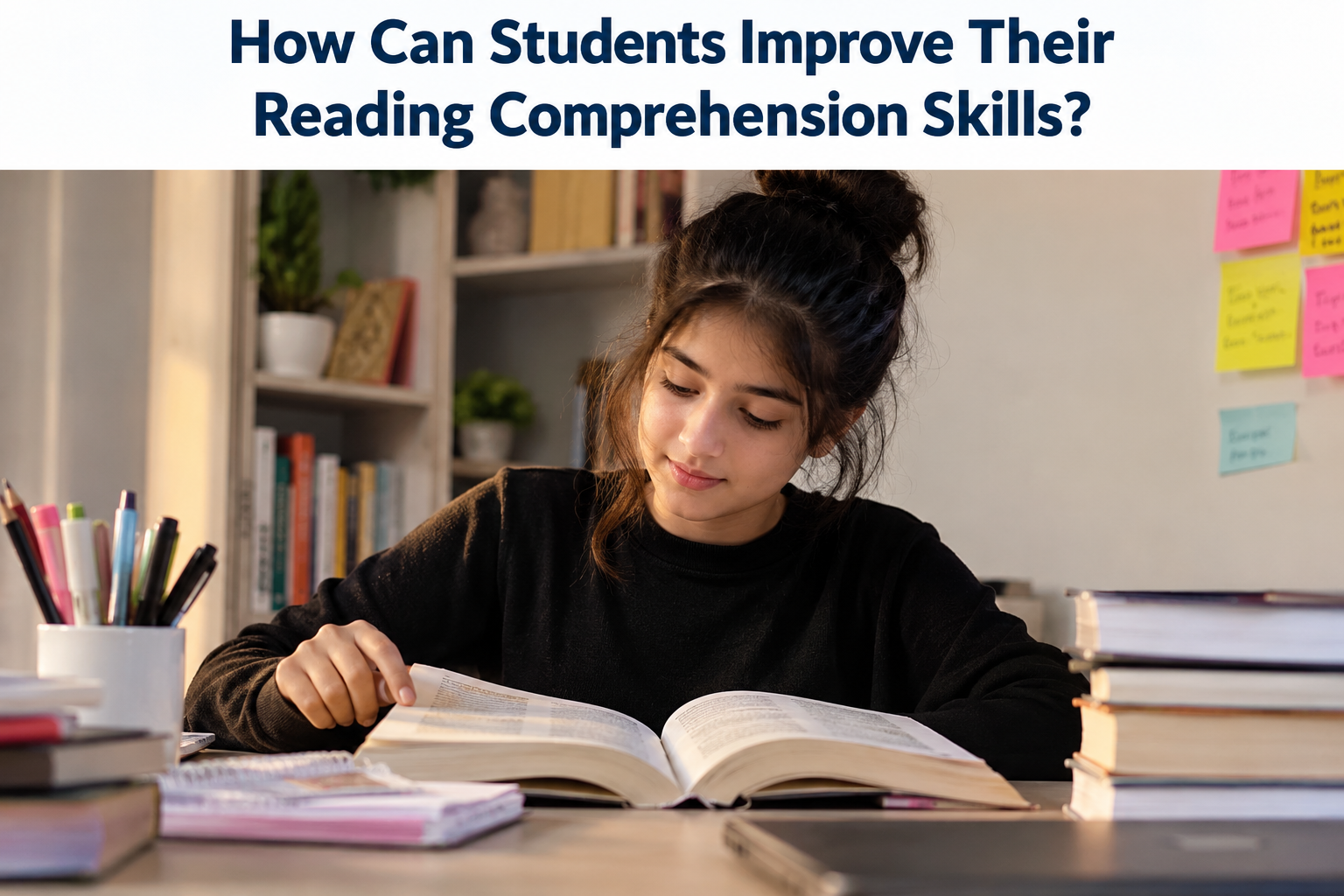
Reading is an important part of education because it helps students gain knowledge, understand new ideas, and develop better thinking abilities. However, reading words from a book and understanding their meaning are two different things. Many students can read a complete chapter but struggle to explain what they have learned. This problem often happens because they focus on finishing the text instead of understanding its message.
Improving reading comprehension skills can help students perform better in school, prepare for examinations, and become more confident learners. Good reading comprehension allows students to identify important information, understand difficult concepts, and connect new knowledge with what they already know.
From studying different educational books and learning methods, I have noticed that reading comprehension is not something students develop overnight. It improves through regular practice, concentration, and effective reading strategies.
In this article, we will explore practical ways students can improve their reading comprehension skills and develop reading habits that support long term learning.
What Are Reading Comprehension Skills?
Reading comprehension is the ability to understand, interpret, and remember information presented in written text. It involves more than recognizing words and reading sentences correctly.
A student with strong reading comprehension skills can understand the main idea of a passage, recognize supporting details, and explain information using simple words.
For example, imagine a student reading a chapter about the water cycle. Instead of memorizing every sentence, the student understands how evaporation, condensation, and precipitation are connected.
This understanding makes it easier to answer questions and remember the lesson.
Reading comprehension also involves thinking carefully about what the writer is trying to communicate. Students must sometimes identify hidden meanings, compare ideas, and draw conclusions from the information provided.
These abilities become increasingly important as students move into higher levels of education.
1. Develop a Regular Reading Habit
One of the best ways to improve reading comprehension skills is to read regularly.
Students who read frequently become more familiar with sentence structures, vocabulary, and different writing styles. Over time, this familiarity makes reading easier and improves understanding.
Students do not need to begin with difficult books. They can start with short stories, educational articles, newspapers, or books that match their reading abilities.
Reading for fifteen to twenty minutes every day can be a useful starting point.
Consistency matters more than reading a large number of pages occasionally.
For example, a student who reads a few pages daily may develop better concentration than someone who reads an entire book only before an examination.
Students should gradually increase the difficulty of their reading materials as their confidence improves.
2. Understand the Purpose Before Reading
Before opening a book or reading a chapter, students should understand why they are reading it.
Having a clear purpose helps the mind focus on important information.
For example, a student reading a history chapter may want to understand the causes of a particular event. Another student reading a science lesson may want to learn how a natural process works.
These goals influence how students approach the text.
Before reading, students can ask themselves simple questions:
- What do I already know about this topic?
- What information do I want to learn?
- What questions should this chapter answer?
Thinking about these questions prepares the mind for learning.
When students read with a purpose, they are less likely to lose concentration or read without understanding.
3. Preview the Chapter Before Reading Carefully
Previewing a chapter is a useful strategy for improving reading comprehension.
Instead of immediately reading every sentence, students can first examine the chapter title, headings, pictures, diagrams, and highlighted terms.
This provides a general idea of what the chapter contains.
For example, if a science chapter includes headings about plants, sunlight, water, and photosynthesis, students can predict that the lesson explains how plants prepare food.
This basic understanding creates a foundation for detailed reading.
Students can also look at questions provided at the end of a chapter. These questions often reveal the important concepts discussed in the lesson.
Previewing does not replace careful reading. It simply helps students organize their thoughts before studying the complete text.
4. Improve Vocabulary Through Everyday Reading
Vocabulary plays an important role in reading comprehension.
When students encounter too many unfamiliar words, they may struggle to understand the meaning of a paragraph.
Developing a stronger vocabulary helps students read different subjects with greater confidence.
One useful method is to learn new words through context.
For example, consider this sentence:
“The exhausted traveler rested under a tree after walking for several hours.”
Even if a student does not know the word “exhausted,” the remaining sentence suggests that the traveler is very tired.
Understanding words through surrounding information can improve reading fluency.
Students should also keep a small vocabulary notebook.
They can write unfamiliar words, their meanings, and example sentences.
Using new words in writing and conversation helps students remember them more effectively.
5. Read Slowly When the Topic Is Difficult
Many students believe that reading quickly means reading effectively.
However, speed is not always a sign of understanding.
Some topics require careful reading because they contain complex explanations, unfamiliar vocabulary, or detailed information.
Students should adjust their reading speed according to the difficulty of the material.
For example, a simple story may be easy to understand through continuous reading. A mathematics explanation or scientific concept may require several careful readings.
When students encounter a confusing sentence, they should stop and examine it.
They can divide a long sentence into smaller parts and identify its main message.
Reading slowly when necessary prevents misunderstandings and creates stronger knowledge.
The goal should always be understanding rather than finishing pages quickly.
6. Ask Questions While Reading
Asking questions is one of the most effective reading comprehension strategies for students.
Questions encourage active thinking and help readers connect with the information.
Instead of accepting every sentence without reflection, students should consider what the text explains and why the information matters.
Useful questions include:
- What is the main idea of this paragraph?
- Why did the writer include this example?
- How does this information connect with the previous section?
- What conclusion can I draw from these details?
- Can I explain this concept using my own words?
For example, while reading about environmental pollution, students might ask why pollution increases in cities and how it affects human life.
These questions encourage deeper understanding.
Students who actively question a text are more likely to notice important ideas and recognize information they have not fully understood.

7. Identify the Main Idea of Each Paragraph
Understanding the main idea is an essential part of reading comprehension.
Every well organized paragraph usually communicates one central point supported by additional information.
Students should practice identifying this central message.
For example, a paragraph might discuss the importance of physical exercise for students. It may explain how exercise supports health, concentration, and energy.
The main idea is that regular exercise benefits students, while the other statements provide supporting details.
Students can practice by reading one paragraph and summarizing its message in a single sentence.
This activity trains the mind to separate important information from additional explanations.
Over time, students become better at understanding longer chapters because they can recognize how individual ideas connect.
8. Take Simple Notes While Reading
Taking notes can improve reading comprehension by helping students organize information.
However, copying complete paragraphs from a textbook is usually not an effective method.
Students should focus on writing important ideas in their own words.
For example, while reading a geography chapter about earthquakes, a student can record the causes, effects, and safety measures under separate headings.
This makes the information easier to review.
Notes can include short explanations, important terms, examples, and questions that need clarification.
Students may also use simple diagrams or concept maps when studying topics that involve relationships between ideas.
The purpose of note taking is not to create another textbook.
It is to develop a clear record of what the student has understood.
9. Summarize Information After Reading
Summarizing is a powerful technique for strengthening reading comprehension skills.
After completing a section, students should close the book and explain what they remember.
They can write a short summary or describe the lesson aloud.
A good summary includes the main idea and the most important supporting points.
For example, after reading about healthy eating habits, a student might summarize the importance of balanced meals, drinking enough water, and choosing nutritious foods.
The summary does not need to repeat the author’s exact sentences.
In fact, explaining information in simple personal language often shows stronger understanding.
If students cannot summarize a paragraph, they may need to reread it and identify the confusing information.
Regular summarizing helps students recognize what they understand and what still requires attention.
10. Connect New Information With Previous Knowledge
Reading becomes easier when students connect new information with things they already know.
The human mind often understands unfamiliar ideas by relating them to familiar experiences.
For example, while reading about evaporation, students can remember how wet clothes become dry when placed in sunlight.
This everyday example makes the scientific process easier to understand.
Similarly, a student learning about business profit can connect the concept with a small shop that earns money by selling products.
These connections make abstract ideas more meaningful.
Students should develop the habit of asking how a new concept relates to previous lessons, daily life, or personal experiences.
Connecting information supports understanding and can improve long term memory.
11. Use Context Clues to Understand Difficult Words
Students sometimes stop reading whenever they encounter an unfamiliar word.
Although checking a dictionary is helpful, doing so repeatedly can interrupt concentration.
Context clues provide another method for understanding vocabulary.
These clues come from the words and sentences surrounding an unfamiliar term.
For example:
“The road was slippery because heavy rain had covered the surface with water.”
Even if a student is unfamiliar with “slippery,” the sentence suggests that the road may be difficult to walk or drive on safely.
Students should first examine the surrounding text and predict the meaning.
They can then check a reliable dictionary to confirm their understanding.
This approach develops independent reading abilities and reduces unnecessary interruptions.
12. Practice Reading Different Types of Text
Students should explore different reading materials instead of depending on one type of book.
Stories, biographies, science articles, historical explanations, and informational essays require slightly different reading approaches.
For example, reading a story helps students understand characters, events, and emotions.
Reading a science article develops the ability to follow explanations and recognize relationships between causes and effects.
Historical texts encourage students to examine events, evidence, and different perspectives.
Exposure to different writing styles helps students become more flexible readers.
It also prepares them for examination questions that may include unfamiliar passages.
Students can begin with materials that interest them and gradually explore new subjects.
13. Improve Concentration During Reading
Concentration is necessary for understanding written information.
When students frequently check their phones, talk to others, or switch between activities, they may find it difficult to follow the meaning of a passage.
A quiet and comfortable reading environment can reduce these distractions.
Students should choose a suitable place with proper lighting and enough space for books and notebooks.
They can also establish short reading sessions.
For example, reading with full attention for twenty minutes may be more productive than spending an hour studying while constantly checking notifications.
Taking short breaks between sessions can help students maintain attention.
A consistent reading routine also teaches the mind to focus during study time.
14. Discuss What You Read With Others
Discussing reading material can improve comprehension because it encourages students to explain their understanding.
Students can talk about books, articles, or lessons with classmates, teachers, or family members.
For example, after reading a historical story, students may discuss why a character made a particular decision.
Different opinions can help them recognize details they initially overlooked.
Group discussions also encourage students to support their answers with information from the text.
If another student understands a concept differently, both readers can return to the passage and examine the evidence.
This practice strengthens communication, reasoning, and comprehension skills.
15. Practice Reading Comprehension Exercises
Regular exercises help students apply reading strategies and measure their progress.
Students can choose short passages and answer questions about the information.
Useful exercises include identifying the main idea, explaining vocabulary, finding supporting details, and drawing conclusions.
Students should also practice answering questions that require information beyond directly stated facts.
For example, a passage may describe a character carrying an umbrella while dark clouds gather.
A question might ask why the character brought the umbrella.
Students can infer that the character expects rain, even if the text does not directly explain the reason.
These exercises develop critical thinking and prepare students for school examinations.
Common Reading Comprehension Mistakes Students Should Avoid
Students sometimes develop habits that make reading more difficult.
One common mistake is reading without checking whether the information makes sense.
Another is memorizing complete sentences without understanding their meaning.
Some students also skip unfamiliar words that are essential to the main idea.
Others highlight nearly every sentence, making it difficult to identify the most important information.
Students should avoid focusing only on reading speed.
Instead, they should regularly check their understanding, review difficult passages, and explain important concepts using their own words.
Recognizing these mistakes is an important step toward becoming a more effective reader.
How Can Students Measure Their Reading Comprehension Progress?
Students can measure their progress through simple activities.
After reading a passage, they can try to explain the main message without looking at the book.
They can also answer comprehension questions and compare their responses with the text.
Keeping a reading journal is another useful method.
Students may record the title of each reading material, new vocabulary, important ideas, and questions they found difficult.
Over several weeks, they may notice improvements in understanding, confidence, and the ability to explain complex information.
Progress should not be measured only by the number of pages completed.
The quality of understanding is more important than reading quantity.
Frequently Asked Questions
What is the best way to improve reading comprehension skills?
Regular reading, asking questions, identifying main ideas, and summarizing information are effective ways to improve reading comprehension. Students should combine these methods rather than depending on only one strategy.
How much should students read every day?
Students can begin with fifteen to twenty minutes of focused reading daily. The duration can gradually increase depending on their age, reading ability, and academic requirements.
Does reading aloud improve comprehension?
Reading aloud can help some students improve attention, pronunciation, and reading fluency. However, students should also practice silent reading and check whether they understand the meaning of the text.
Why do students forget information after reading?
Students may forget information when they read passively, become distracted, or fail to review important ideas. Summarizing, retrieving information from memory, and revisiting lessons over time can improve retention.
Can reading comprehension improve at any age?
Yes. Reading comprehension can improve through consistent practice at different ages. Students can develop stronger skills by choosing suitable materials and gradually working with more challenging texts.
Conclusion
Improving reading comprehension skills is an important part of becoming a successful student. Strong comprehension helps learners understand lessons, remember important information, and approach unfamiliar topics with greater confidence.
Students can improve their reading abilities by developing regular reading habits, learning new vocabulary, asking thoughtful questions, identifying main ideas, and summarizing information in their own words.
Reading different materials, reducing distractions, and discussing lessons with others can also strengthen understanding.
The most important lesson is that effective reading is not about finishing the greatest number of pages. It is about understanding the information and being able to explain what has been learned.
With patience, consistent practice, and the right reading strategies, students can gradually become more confident, independent, and capable readers.


