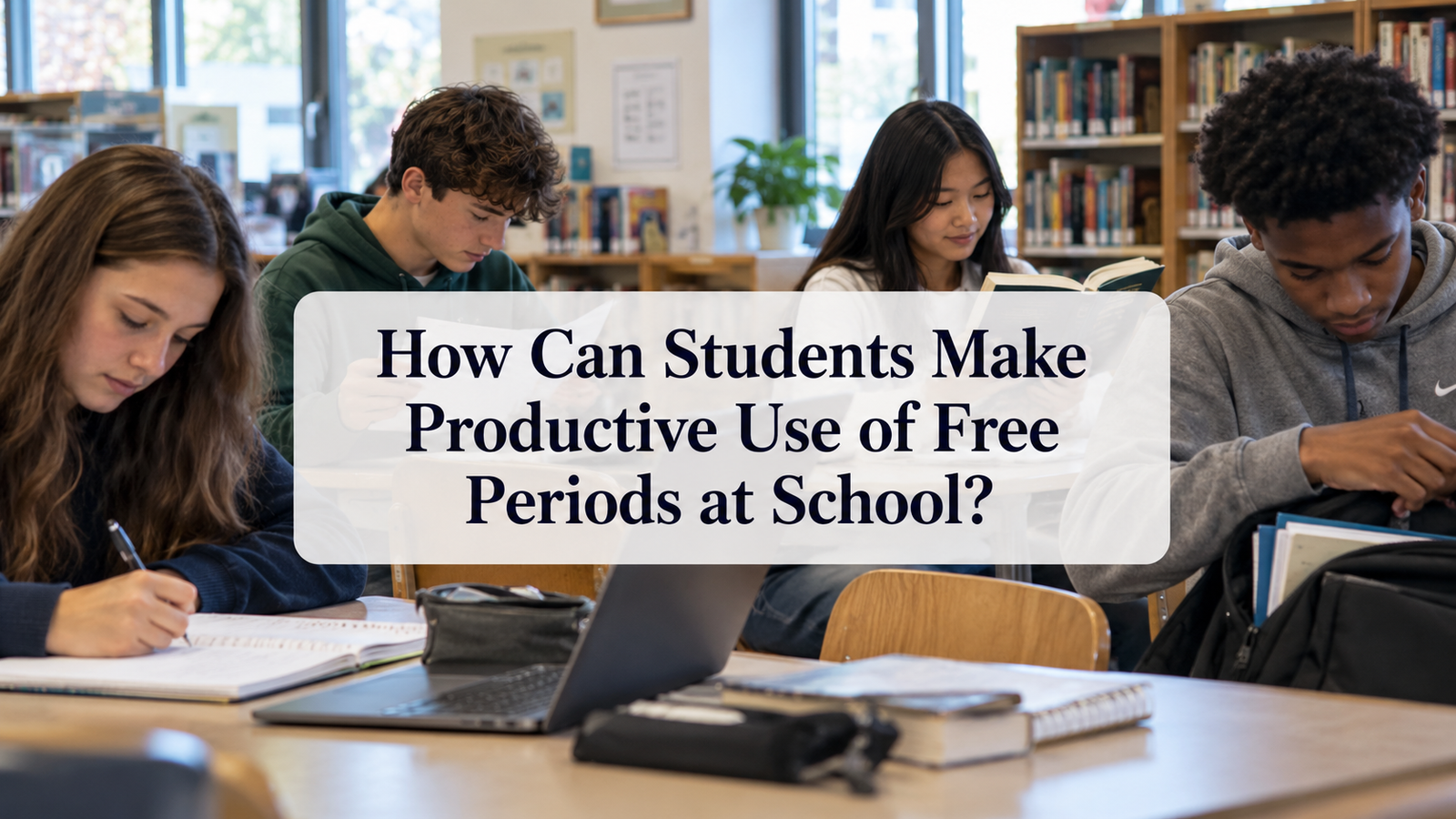
School life is filled with classes, homework, assignments, examinations, and different activities. Students usually follow a fixed timetable throughout the day, but sometimes they get free periods between lessons. These free periods may happen when a teacher is absent, a class finishes early, or the school timetable includes independent study time.
Many students consider free periods an opportunity to relax, talk with friends, or spend time without doing anything important. Although relaxation is necessary, using some of this time wisely can make school life easier and more organized.
Learning how students can make productive use of free periods at school is an important part of developing good study habits. Even a short period of 20 or 30 minutes can help students complete small tasks, revise lessons, prepare for upcoming classes, or improve useful skills.
The purpose of using free periods productively is not to study continuously. It is about finding a healthy balance between learning, relaxation, and personal development.
1. Complete Pending Homework During Free Periods
One of the most useful ways to spend free periods at school is to complete pending homework. Students often receive assignments from several subjects on the same day. When these tasks are left until evening, they can become difficult to manage.
A free period provides an opportunity to finish smaller homework tasks before returning home.
For example, a student may have five mathematics questions, a short English exercise, and a science worksheet. Instead of leaving everything for the evening, the student can complete one of these tasks during a free period.
This practice helps reduce the amount of homework that remains after school. It also gives students more time for family activities, hobbies, and relaxation.
However, students should focus on understanding their homework rather than completing it quickly. Correct learning is always more valuable than simply finishing an assignment.
2. Review Lessons Taught Earlier in the Day
Reviewing lessons is another effective way to use free periods at school. Students learn different topics throughout the day, and remembering every detail can become challenging.
A short review immediately after a lesson can help students identify what they understand and what needs more attention.
For example, after attending a biology class, a student can spend ten minutes reviewing important definitions, diagrams, and explanations.
Students can also look through their class notes and highlight important information.
Regular revision helps students prepare for examinations without depending entirely on long study sessions at home.
Instead of waiting until examination week, students can gradually strengthen their understanding through short and regular reviews.
3. Prepare for the Next Classroom Lesson
Free periods can also be used to prepare for upcoming classes. Students often understand lessons more easily when they already have some basic knowledge of the topic.
Before the next class begins, students can open their textbooks and read the introduction to the upcoming chapter.
They do not need to understand every detail. The main purpose is to become familiar with the subject.
For example, if the next lesson is about the solar system, reading a few paragraphs about planets can help students follow the teacher’s explanation.
Students can also write down questions about information they find confusing.
Preparing before class encourages curiosity and makes classroom discussions more meaningful.
This simple habit can gradually improve confidence and participation in different subjects.
4. Organize School Bags and Study Materials
A disorganized school bag can create unnecessary problems during the school day. Students sometimes waste valuable minutes searching for notebooks, pens, assignments, and textbooks.
Free periods offer a suitable opportunity to organize these materials.
Students can arrange their books according to the timetable, place completed homework in the correct folders, and remove unnecessary papers.
They can also check whether their pencils, erasers, rulers, and other supplies are available.
Keeping study materials organized helps students move smoothly between classes.
It also reduces the chances of forgetting important assignments or losing useful notes.
A few minutes spent organizing school supplies can save considerable time throughout the week.
5. Read Educational Books and Useful Articles
Reading is one of the best activities students can choose during free periods. It helps develop vocabulary, comprehension, general knowledge, and imagination.
Students do not always need to read textbooks. They can explore storybooks, biographies, history books, science magazines, and other educational materials.
For example, a student interested in technology may enjoy reading about computers, inventions, or space exploration.
Another student may prefer literature, geography, or historical events.
The important thing is to select material that encourages learning and curiosity.
Even reading five or six pages during a free period can become a valuable habit when practiced regularly.
Schools with libraries provide an excellent environment for developing this interest.
Reading also offers a calm and enjoyable alternative to unnecessary classroom noise.
6. Practice Difficult Subjects
Every student has subjects that feel easier and others that require additional effort. Free periods can provide extra practice time for challenging topics.
Students can use this time to solve mathematics problems, review grammar rules, practice scientific calculations, or revise unfamiliar vocabulary.
For example, a student struggling with fractions can solve a few practice questions during a free period.
Another student who finds English grammar difficult can review sentence structures and complete short exercises.
The goal should be gradual improvement rather than immediate perfection.
Working on difficult subjects in small sessions can make learning feel more manageable.
Students should also identify mistakes and understand why they happened.
This approach develops stronger problem solving skills and encourages independent learning.
7. Make a Daily Study Plan
Time management becomes easier when students know which tasks need their attention.
A free period is a good opportunity to prepare or update a daily study plan.
Students can write down homework assignments, upcoming tests, project deadlines, and important school activities.
They can then decide which tasks should be completed first.
For example, an assignment due tomorrow should usually receive attention before a project that is due next month.
A simple notebook or school planner is enough for this activity.
Students do not need complicated schedules. A short list of realistic goals can be more helpful than an overly detailed timetable.
Planning during free periods helps students approach the rest of the day with greater clarity.
8. Work on School Projects and Assignments
School projects often require research, planning, writing, and teamwork. Completing these activities at the last moment can create unnecessary pressure.
Students can use free periods to make gradual progress on their projects.
They may collect information, prepare outlines, review instructions, or divide responsibilities among group members.
For example, students working on a geography presentation can use a free period to identify important points and organize their ideas.
If group work is permitted, they can discuss their responsibilities quietly without disturbing other students.
Completing small parts of a project regularly makes the overall assignment easier to manage.
It also provides enough time to review the final work before submission.
9. Ask Teachers for Academic Guidance
Sometimes students leave a classroom without fully understanding a concept. Instead of ignoring the confusion, they can use an available free period to seek clarification.
If a teacher is available and school rules permit it, students can ask questions about difficult topics, assignments, or examination preparation.
For example, a student may need help understanding a mathematical formula or the structure of an essay.
Before approaching a teacher, students should identify their exact difficulty.
Clear questions make it easier for teachers to provide useful explanations.
Seeking academic guidance shows responsibility and willingness to improve.
Students can also ask teachers for recommendations about additional reading materials and effective study techniques.
10. Develop Better Writing Skills
Writing is an important skill in almost every academic subject. Students need it for examinations, assignments, reports, and classroom activities.
Free periods offer an opportunity to practice writing without the pressure of completing a formal examination.
Students can write short paragraphs, summarize textbook chapters, practice essay introductions, or improve sentence formation.
For example, a student can choose a familiar topic such as environmental protection and write a short paragraph explaining its importance.
After writing, the student can check spelling, grammar, punctuation, and clarity.
Regular writing practice helps students express ideas more confidently.
It also encourages them to organize information logically instead of memorizing complete answers.
11. Use Free Time for Group Study
Studying with classmates can make difficult subjects easier to understand. When school rules allow group discussions, free periods can be used for cooperative learning.
Students can explain concepts to one another, compare notes, or discuss questions from previous lessons.
For example, one student may understand a science concept well while another is better at mathematics.
By helping each other, both students can strengthen their learning.
Group study should remain focused and respectful. Excessive talking can disturb nearby classrooms and reduce productivity.
Small groups with clear learning goals usually work better than large groups without a plan.
Students should also avoid simply copying answers from classmates.
The real benefit of group study comes from exchanging ideas and understanding concepts.
12. Practice Communication and Presentation Skills
Good communication skills are useful both inside and outside school. Students who learn to express their thoughts clearly may feel more confident during presentations, discussions, and future interviews.
Free periods can be used to practice these abilities.
Students may prepare short speeches, explain educational topics to classmates, or rehearse upcoming presentations.
For example, a student preparing a history presentation can practice explaining important events in a clear sequence.
Students can also improve their listening skills by allowing others to speak without interruption.
These activities help develop confidence, patience, and respect for different opinions.
When practiced regularly, communication skills can support academic performance and personal development.
13. Visit the School Library
A school library provides a peaceful environment for reading, research, and independent learning.
When students have longer free periods and permission to leave the classroom, visiting the library can be a productive choice.
They can borrow books, explore reference materials, complete assignments, or study subjects that interest them.
Libraries also provide opportunities to discover information beyond regular textbooks.
For example, a student studying environmental science may find useful books about forests, wildlife, and climate.
Using the library regularly can encourage research habits and independent thinking.
Students should follow library rules and respect others who are reading or studying.
14. Take Short Breaks to Refresh the Mind
Productive use of free periods does not mean studying every minute. Students need adequate breaks to maintain concentration and avoid unnecessary tiredness.
After several classroom lessons, taking a short break can help students feel refreshed.
They can drink water, eat a healthy snack if permitted, stretch gently, or spend a few minutes relaxing.
Students may also enjoy quiet conversations with friends.
The important thing is to avoid activities that create excessive noise or interfere with school responsibilities.
A balanced free period may include both study and relaxation.
For example, students can spend 20 minutes completing an assignment and use the remaining ten minutes to rest.
This approach supports productivity without making the school day feel exhausting.
15. Reflect on Personal Learning Progress
Students can also use free periods to think about their academic progress.
Self reflection helps them recognize strengths, identify difficulties, and make better learning decisions.
They can ask themselves simple questions.
Which subject did I understand well today? Which lesson was difficult? Did I complete my homework on time? What can I improve tomorrow?
Writing short answers in a notebook can make this activity more useful.
For example, a student who frequently forgets assignments may realize that using a daily planner would help.
Another student may discover that reviewing notes after class improves understanding.
Reflecting on personal progress encourages students to take greater responsibility for their education.
How to Create a Simple Free Period Routine
Students do not need to follow the same activity during every free period. The best choice depends on their workload, energy level, and school rules.
A simple routine can help them make better decisions.
Here is an example of how students can use a 40 minute free period.
| Time | Activity |
|---|---|
| 5 minutes | Check homework and upcoming deadlines |
| 15 minutes | Complete an important academic task |
| 10 minutes | Review a lesson or prepare for the next class |
| 5 minutes | Organize notebooks and school materials |
| 5 minutes | Relax and prepare for the next lesson |
This timetable is only an example. Students can adjust it according to their needs.
On a particularly busy day, completing homework may be the main priority. On another day, reading a book or taking a longer break may be more useful.
Consistency matters more than following a perfect routine.
Common Mistakes Students Should Avoid During Free Periods
Although free periods provide useful opportunities, students sometimes develop habits that prevent them from using this time effectively.
One common mistake is spending the entire period in unnecessary conversations. Social interaction is important, but it should not replace every opportunity for learning.
Another mistake is starting too many activities without completing any of them. Students should select one or two realistic tasks.
Some students also use free periods only for last minute examination preparation. Regular revision throughout the school year is generally more manageable than studying everything immediately before a test.
Students should also avoid disturbing classmates who are studying or relaxing quietly.
Finally, they should not feel guilty about taking necessary breaks. Rest is a valuable part of a balanced school routine.
Frequently Asked Questions
What is the best activity during a free period at school?
The best activity depends on a student’s immediate needs. Completing homework, reviewing lessons, reading educational books, and preparing for upcoming classes are all productive options.
Can students use free periods for relaxation?
Yes. Relaxation is important, especially after several demanding lessons. Students can divide their free periods between academic activities and short breaks.
How can students use a 20 minute free period effectively?
Students can choose one small task, such as reviewing class notes, completing a worksheet, practicing a few mathematics questions, or organizing homework assignments.
Why are free periods important for students?
Free periods provide opportunities for independent learning, time management, revision, personal development, and necessary rest. Using them wisely can make the school day more manageable.
Should students study during every free period?
No. Students should maintain a balance between studying and resting. The most productive activity may sometimes be taking a short break before the next class.
Conclusion
Understanding how students can make productive use of free periods at school can help them develop better study habits and manage academic responsibilities more effectively.
Free periods are valuable opportunities that students can use for completing homework, reviewing lessons, preparing for classes, reading books, improving skills, and organizing study materials.
However, productivity should never mean studying without rest. Students need time to relax, communicate with friends, and refresh their minds.
The most effective approach is to choose activities according to personal needs and available time.
Even small actions, such as reviewing one lesson or completing a short assignment, can make a meaningful difference when repeated regularly.
By treating free periods as opportunities for both learning and personal growth, students can become more organized, confident, and responsible throughout their school years.