
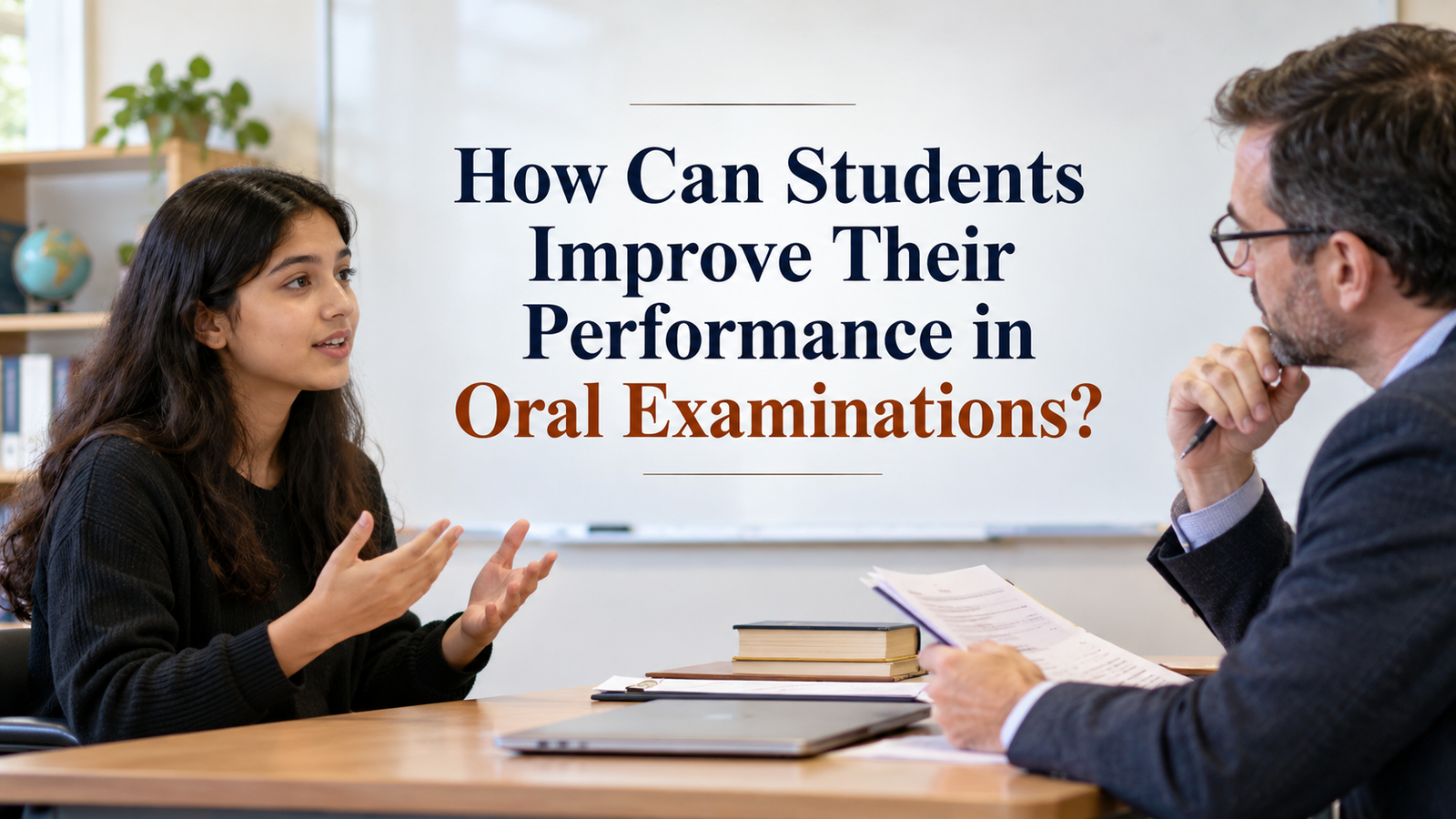
Oral examinations are an important part of education because they allow students to demonstrate their knowledge through spoken answers. Unlike written examinations, oral exams require students to think quickly, organize their ideas, and communicate clearly in front of a teacher or examiner. Many students understand their subjects well but struggle to explain their answers when speaking. This often happens because of nervousness, limited speaking practice, or a lack of confidence.
Improving performance in oral examinations requires more than memorizing textbook information. Students need to develop communication skills, understand their subjects, practice answering questions, and learn how to remain calm under pressure.
From studying different learning methods and examination preparation techniques, one important lesson becomes clear. Students who practice explaining information in their own words are often better prepared for oral assessments than those who depend entirely on memorization.
This article explains practical strategies that can help students improve their performance in oral examinations and communicate their knowledge with greater confidence.
1. Understand the Purpose of Oral Examinations
The first step toward improving oral examination performance is understanding why these assessments are conducted.
Teachers use oral examinations to evaluate students’ understanding, communication skills, reasoning abilities, and knowledge of a particular subject.
An oral examination may include direct questions, discussions, presentations, or explanations of academic concepts.
For example, a science teacher may ask students to explain how plants produce food. Instead of writing an answer, students must describe the process verbally.
A student who understands photosynthesis can explain the concept using simple language and relevant examples.
Understanding the purpose of oral examinations helps students focus on learning rather than memorizing answers without understanding their meaning.
2. Develop a Strong Understanding of the Subject
One of the most effective ways to improve performance in oral examinations is to develop a clear understanding of the subject.
Students sometimes memorize entire paragraphs from textbooks and expect to repeat them during examinations. However, this method becomes difficult when an examiner asks an unexpected question.
A better approach is to understand the main ideas, important definitions, and relationships between different concepts.
For example, while preparing for a history examination, students should understand the causes and consequences of historical events instead of memorizing dates alone.
When students understand a topic properly, they can explain it in different ways.
They can also answer follow up questions without depending entirely on memorized sentences.
Reading textbooks carefully, preparing personal notes, and discussing lessons with classmates can improve subject understanding.
3. Practice Speaking Answers Aloud
Reading information silently is helpful, but oral examinations require spoken communication.
Students should therefore practice explaining their answers aloud.
After studying a topic, close the textbook and explain the main points using your own words.
Imagine that you are teaching the subject to someone who has never studied it before.
For example, after reading a geography lesson about earthquakes, explain what causes earthquakes, how they affect communities, and what safety measures people can take.
Speaking aloud helps students identify areas where their understanding is incomplete.
It also improves sentence formation, pronunciation, and speaking confidence.
Regular speaking practice makes the examination environment feel more familiar.
4. Prepare for Common Oral Examination Questions
Students can improve their oral examination preparation by identifying questions that teachers are likely to ask.
Review important chapters, classroom discussions, previous assessments, and learning objectives.
Prepare questions that test definitions, explanations, comparisons, examples, and personal understanding.
Common oral examination questions include:
- Can you explain this concept in your own words?
- What are the main causes of this problem?
- How does this process work?
- Can you provide an example?
- What is the difference between these two ideas?
- Why is this topic important?
Students should practice answering these questions without reading directly from their notes.
The purpose is not to memorize every possible response. Instead, it is to become comfortable organizing information and explaining ideas.
5. Improve Speaking Confidence Through Regular Practice
Confidence plays an important role in oral examination performance.
Some students become nervous when speaking in front of teachers, even when they know the correct answers.
One way to develop confidence is to begin practicing in a comfortable environment.
Students can start by answering questions while sitting alone in their rooms.
After becoming comfortable, they can practice with family members or trusted friends.
Eventually, they can participate in classroom discussions and group activities.
Each successful speaking experience helps students become more comfortable expressing their ideas.
Confidence usually develops gradually through preparation and repeated practice.
Students should focus on improving their speaking abilities rather than expecting perfect performance immediately.
6. Organize Answers Before Speaking
A common mistake during oral examinations is beginning an answer without thinking about its structure.
This can lead to confusing explanations, unnecessary repetition, and incomplete responses.
Students should take a brief moment to organize their thoughts before speaking.
A useful answer structure includes three parts.
Introduction: Begin with a direct response to the question.
Explanation: Describe the main points clearly.
Example: Provide an example when it helps explain the concept.
For instance, if an examiner asks why regular exercise is important, a student can begin by explaining that exercise supports physical health.
The student can then discuss benefits such as improved strength, fitness, and overall well being.
Finally, the student can provide examples of physical activities such as walking, swimming, or cycling.
This structure makes answers easier to follow.
7. Speak Clearly and at a Comfortable Speed
Clear communication is essential for successful oral examinations.
Students sometimes speak too quickly because they feel nervous or want to finish their answers immediately.
Speaking too fast can make explanations difficult to understand.
On the other hand, speaking very slowly may interrupt the natural flow of communication.
Students should aim for a comfortable speaking speed.
Pronounce important terms carefully and use simple sentences whenever possible.
Short pauses between ideas can make explanations clearer.
Recording practice answers on a phone can help students evaluate their speaking speed, pronunciation, and clarity.
Listening to these recordings allows students to identify habits that need improvement.
8. Learn to Manage Examination Anxiety
Feeling nervous before an oral examination is common.
Students may worry about forgetting information, making mistakes, or receiving difficult questions.
However, excessive anxiety can interfere with concentration and communication.
Developing a simple preparation routine can help students manage nervousness.
Before the examination, students should review important concepts rather than attempting to memorize an entire textbook at the last moment.
Getting sufficient sleep and arriving early can also reduce unnecessary pressure.
When answering questions, students can take a slow breath and focus on explaining one idea at a time.
If a question feels difficult, taking a short moment to think is better than responding immediately without understanding it.
A calm approach can help students communicate more effectively.

9. Practice Through Mock Oral Examinations
Mock oral examinations are among the most practical methods for improving speaking performance.
A mock examination creates a situation similar to the actual assessment.
Students can ask a teacher, friend, or family member to act as the examiner.
The examiner asks questions while the student responds without using textbooks or prepared answers.
After completing the session, the student can receive feedback about communication, accuracy, confidence, and answer organization.
Mock examinations also help students become familiar with examination pressure.
For better results, students should practice questions of different difficulty levels.
Some questions should test basic knowledge, while others should require explanations, comparisons, and reasoning.
Repeated practice helps identify weaknesses before the actual examination.
10. Develop Active Listening Skills
Oral examinations involve listening as well as speaking.
Students must understand the examiner’s question before preparing an answer.
Sometimes students begin speaking too early and answer a different question from the one asked.
Active listening can prevent this problem.
Students should pay attention to important words and understand what the examiner wants.
For example, the question “What is photosynthesis?” requires a definition or explanation.
However, “Why is photosynthesis important?” asks students to discuss its significance.
Although both questions concern the same topic, they require different answers.
If a question is unclear, students can politely ask the examiner to repeat or explain it.
Understanding the question correctly is more important than answering immediately.
11. Use Examples to Explain Difficult Concepts
Examples can make oral answers more effective because they connect theoretical knowledge with practical situations.
Students should learn to support important explanations with relevant examples.
For instance, during an economics oral examination, a student may be asked to explain the concept of demand.
The student can define demand and then describe how customers may purchase fewer products when prices increase, assuming other conditions remain unchanged.
This example demonstrates an understanding of the concept rather than simple memorization.
Similarly, science students can explain physical processes through everyday observations.
However, examples should remain relevant to the question.
Providing too many unrelated details can make an answer confusing.
12. Improve Vocabulary and Subject Terminology
Every academic subject contains important terms that students should understand and pronounce correctly.
Using accurate terminology can make oral answers clearer and more precise.
For example, biology students may need to explain words such as respiration, digestion, and reproduction.
Students studying mathematics may need to understand terms such as equation, variable, and probability.
A useful strategy is to maintain a small vocabulary notebook.
Write important terms, their meanings, and simple example sentences.
Practice pronouncing unfamiliar words aloud.
However, students should avoid using complicated vocabulary merely to impress an examiner.
Simple and accurate explanations are generally more effective than unnecessarily complex language.
13. Learn How to Handle Difficult Questions
Not every question in an oral examination will be easy.
Sometimes students may encounter unfamiliar questions or temporarily forget information.
In these situations, remaining calm is important.
Students should listen carefully and identify any part of the question they understand.
They can begin with a relevant concept and explain their reasoning when appropriate.
If the question contains several parts, addressing the familiar parts first may help organize the answer.
Students should avoid inventing information when they do not know the correct response.
An honest acknowledgment of uncertainty is better than presenting incorrect information confidently.
When permitted, students can also ask for clarification.
The ability to respond thoughtfully to challenging questions is an important academic skill.
14. Pay Attention to Body Language
Body language can influence how confidently and clearly students communicate during oral examinations.
Maintaining a comfortable posture, making natural eye contact, and avoiding unnecessary movements can support effective communication.
Students should sit or stand upright without becoming overly stiff.
Looking toward the examiner while speaking demonstrates attention and engagement.
However, continuous eye contact is not necessary.
Students should focus on communicating naturally rather than trying to control every movement.
Excessive hand movements, looking repeatedly at the floor, or constantly adjusting clothing may distract from the explanation.
Practicing in front of a mirror or recording a mock examination can help students become aware of their body language.
15. Use Feedback to Improve Future Performance
Feedback is one of the most valuable tools for improving oral examination skills.
After practicing or completing an examination, students should identify what went well and what needs improvement.
A teacher may explain that a student understands the subject but needs to organize answers more clearly.
Another student may receive feedback about pronunciation or speaking speed.
Instead of becoming discouraged, students should use this information to guide future practice.
Keeping a simple record of common mistakes can be helpful.
For example, a student may notice a habit of repeating the same words or providing lengthy introductions.
Focusing on one improvement at a time makes progress easier to manage.
16. Follow a Consistent Preparation Schedule
Successful oral examination preparation becomes easier when students follow a regular study routine.
Studying everything the night before an examination can create unnecessary stress.
A better approach is to divide the syllabus into manageable sections.
Students can dedicate time each day to reviewing concepts, speaking aloud, and practicing questions.
For example, a student preparing over seven days might spend the first few days understanding the subject and preparing notes.
The following days can focus on spoken explanations and mock examinations.
The final day can be used for reviewing important points and resting adequately.
Regular preparation allows students to strengthen their understanding without feeling overwhelmed.
17. Avoid Common Oral Examination Mistakes
Certain habits can negatively affect oral examination performance even when students have studied properly.
One common mistake is memorizing answers without understanding them.
Another is speaking continuously without checking whether the answer addresses the question.
Some students also provide extremely short responses when a detailed explanation is required.
Others include unnecessary information because they believe longer answers always receive better marks.
Students should remember that a clear, accurate, and relevant answer is more valuable than an unnecessarily long explanation.
It is also important to avoid interrupting the examiner or becoming defensive when asked follow up questions.
Listening respectfully and responding thoughtfully creates a more productive examination experience.
18. Build Long Term Communication Skills
Improving oral examination performance should not be limited to examination preparation alone.
Students can develop stronger communication skills through everyday academic activities.
Participating in classroom discussions, delivering short presentations, reading aloud, and explaining lessons to classmates can provide regular speaking opportunities.
Group study sessions are also useful when students take turns asking and answering questions.
Students can even practice by summarizing a chapter in two or three minutes.
These activities encourage clear thinking and help students express ideas naturally.
Over time, stronger communication skills can support academic presentations, interviews, professional discussions, and future learning opportunities.
Frequently Asked Questions About Oral Examinations
How can students prepare for an oral examination at home?
Students can prepare at home by reviewing important topics, creating practice questions, and explaining answers aloud. Recording spoken responses and conducting mock examinations with family members can also improve confidence.
What should students do if they forget an answer during an oral examination?
Students should remain calm and take a brief moment to think. They can try to recall related concepts or explain the part they understand. If they genuinely do not know the answer, they should acknowledge their uncertainty rather than guess without evidence.
How can shy students become confident in oral examinations?
Shy students can begin practicing alone before gradually speaking with friends, family members, and teachers. Regular speaking practice and constructive feedback can help reduce nervousness and improve confidence.
Is memorization useful for oral examination preparation?
Memorization can help students remember definitions, formulas, and important facts. However, understanding the subject is more useful when students must explain concepts or answer unexpected questions.
How long should students practice speaking before an oral examination?
The appropriate practice time depends on the subject and the student’s preparation level. Even 15 to 20 minutes of focused speaking practice each day can be useful when combined with regular study and revision.
Conclusion
Improving performance in oral examinations requires a combination of subject knowledge, speaking practice, confidence, and effective preparation. Students should focus on understanding academic concepts, organizing their answers, listening carefully, and explaining information in simple language.
Regular mock examinations, constructive feedback, and consistent study routines can make oral assessments less intimidating. Students should also learn to manage nervousness, respond thoughtfully to difficult questions, and communicate with clarity.
The most important lesson is that oral examination success does not depend on speaking perfectly or memorizing every sentence. It depends on understanding the subject and expressing that understanding effectively.
With patience, preparation, and regular practice, students can gradually become more confident speakers and improve their performance in oral examinations.


