
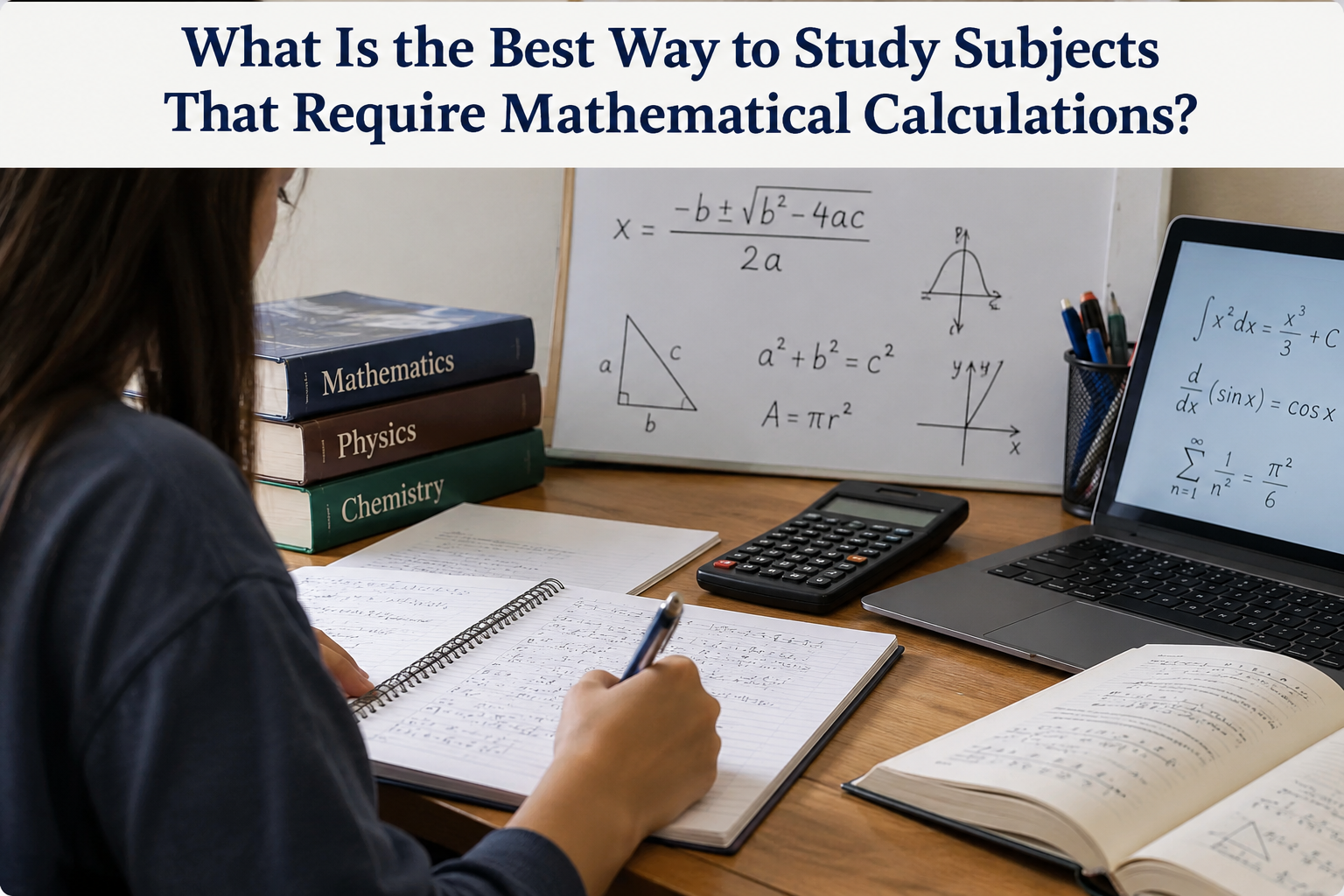
Studying subjects that involve mathematical calculations can sometimes feel challenging, especially when students need to understand formulas, solve numerical problems, and remember different methods. Mathematics, physics, chemistry, accounting, economics, and engineering all require strong calculation skills. However, learning these subjects does not have to be difficult when students follow the right study methods.
The best way to study subjects that require mathematical calculations is to understand basic concepts, practice problems regularly, and develop a clear method for solving questions. Instead of memorizing every formula without understanding its purpose, students should focus on learning how mathematical principles work and how they can be applied to different situations.
While exploring different educational books and learning strategies, one important idea becomes clear. Mathematical skills improve through understanding, consistent practice, and careful examination of mistakes. Students who develop these habits often become more comfortable with numerical subjects.
This article explains practical study techniques that can help students improve mathematical calculation skills, understand complex formulas, and solve problems with greater confidence.
1. Understand Basic Mathematical Concepts First
The first step in studying calculation based subjects is developing a strong understanding of basic mathematical concepts.
Many students experience difficulties with advanced calculations because they have not completely understood earlier lessons. For example, students learning algebra may struggle with equations if they are unfamiliar with fractions, multiplication, or negative numbers.
Before moving toward complicated problems, students should review the essential concepts related to the topic.
A student studying physics should understand basic algebra before solving equations involving speed, distance, and time. Similarly, students learning accounting should understand addition, subtraction, percentages, and financial calculations.
Learning mathematical concepts in the correct order creates a stronger foundation.
Students should also ask themselves why a particular mathematical rule works instead of simply accepting it as something to memorize.
This habit encourages deeper understanding and makes advanced calculations easier to learn.
2. Learn the Meaning Behind Mathematical Formulas
Mathematical formulas are important tools for solving numerical problems. However, memorizing formulas without understanding them can make learning more difficult.
A better approach is to understand what each formula represents and when it should be used.
For example, the formula for calculating speed is:
Speed = Distance ÷ Time
Instead of memorizing these words alone, students should understand that speed describes how much distance an object travels during a particular period.
If a vehicle travels 120 kilometers in 2 hours, its average speed is:
120 ÷ 2 = 60 kilometers per hour.
Understanding this relationship helps students recognize how the formula works.
Students can also explore how formulas change when different values are unknown.
For example:
Distance = Speed × Time
Time = Distance ÷ Speed
Learning the relationships between variables makes mathematical formulas easier to remember and apply.
3. Practice Mathematical Problems Every Day
Regular practice is one of the most effective ways to improve mathematical calculation skills.
Reading mathematical examples can help students understand a topic, but solving problems independently is necessary for developing practical ability.
Students should try to practice mathematical questions every day, even when they have limited time.
A focused practice session of 20 to 30 minutes can be useful when students concentrate on understanding and solving problems.
For example, a student learning algebra might solve five equations daily. Another student studying chemistry might practice calculations involving molar mass, concentration, or chemical quantities.
The goal should not be completing the greatest number of questions.
Instead, students should focus on solving problems correctly and understanding the steps involved.
Consistent mathematical practice helps students recognize familiar question patterns and improves their ability to approach new problems.
4. Solve Problems Step by Step
One common mistake students make when solving numerical questions is attempting to complete several calculations mentally.
Although mental mathematics is useful, complicated problems are often easier to solve when students write down each step.
A clear mathematical solution usually includes understanding the question, identifying known values, selecting the correct formula, performing calculations, and checking the answer.
Consider a simple example:
A student purchases 4 notebooks for 80 rupees each.
To calculate the total cost:
Cost of one notebook = 80 rupees
Number of notebooks = 4
Total cost = 80 × 4
Total cost = 320 rupees
Writing each step makes the calculation easier to follow.
This approach becomes particularly useful when solving longer problems in physics, accounting, statistics, and engineering.
It also helps students identify mistakes without repeating the entire calculation.
5. Understand the Question Before Starting Calculations
Many mathematical mistakes happen because students begin solving questions without fully understanding what is being asked.
Before performing calculations, students should read the problem carefully.
They should identify the available information and determine which value needs to be calculated.
For example, a word problem may provide the distance traveled and the speed of a vehicle while asking students to calculate the travel time.
Students need to recognize that the required formula is:
Time = Distance ÷ Speed
Reading the problem carefully helps students choose the correct mathematical method.
For longer questions, it can be helpful to underline important numbers and write down the unknown quantity.
Students should also pay attention to measurement units, including meters, kilometers, seconds, hours, grams, and kilograms.
Understanding the question properly can prevent unnecessary calculation errors.
6. Create a Separate Notebook for Mathematical Formulas
Keeping a dedicated formula notebook is a useful study strategy for calculation based subjects.
Students can organize important formulas according to chapters and topics.
For example, a mathematics notebook might contain formulas related to algebra, geometry, percentages, and trigonometry.
A physics notebook could include equations related to motion, force, energy, electricity, and pressure.
Students should write a short explanation beside each formula describing its purpose.
They can also include one solved example to demonstrate how the formula is applied.
This approach makes revision more organized.
Instead of searching through several textbooks before an examination, students can quickly review essential formulas in one place.
However, the notebook should support understanding rather than replace regular problem solving.
7. Start With Easy Problems Before Attempting Difficult Questions
Learning mathematical calculations becomes easier when students gradually increase the difficulty of their practice questions.
Beginning with complicated problems can create confusion, especially when the topic is unfamiliar.
Students should first solve basic examples that demonstrate the main concept.
After understanding these examples, they can move toward questions that involve multiple steps.
For example, when studying percentages, students might begin by calculating 10 percent of 200.
10 percent of 200 = 20
After mastering simple calculations, they can attempt problems involving discounts, profit percentages, and percentage changes.
This gradual learning process helps students build confidence.
It also allows them to recognize how basic mathematical ideas are used in more advanced situations.
Students should avoid comparing their speed with others and focus on improving their own understanding.
8. Learn From Mathematical Mistakes
Making mistakes is a normal part of learning subjects that involve calculations.
However, students can improve more effectively when they examine why their answers were incorrect.
After completing a practice exercise, students should compare their solutions with reliable answers.
If a mistake appears, they should identify whether it resulted from misunderstanding the concept, selecting the wrong formula, or making an arithmetic error.
For example, a student may understand the correct equation but accidentally use addition instead of multiplication.
Another student may perform the calculations correctly but forget to convert centimeters into meters.
These mistakes require different solutions.
Keeping a small record of repeated errors can help students identify areas that need additional practice.
Over time, reviewing mistakes can improve calculation accuracy and reduce similar errors during examinations.
9. Use Real Life Examples to Understand Calculations
Mathematical learning becomes more meaningful when students connect numerical concepts with everyday activities.
Many situations involve mathematics, even when people do not consciously recognize it.
Shopping involves addition, subtraction, multiplication, and percentages.
Cooking may involve fractions, ratios, and measurements.
Travel planning includes calculations related to distance, time, and speed.
For example, suppose a shop offers a 20 percent discount on an item priced at 1,000 rupees.
The discount amount is:
1,000 × 20 ÷ 100 = 200 rupees
The final price becomes:
1,000 − 200 = 800 rupees
This practical example demonstrates how percentages are used in everyday financial decisions.
Connecting mathematics with familiar situations can help students understand the purpose of their lessons and remember important concepts.
10. Practice Without Looking at Solved Examples
Textbooks often provide detailed examples before presenting practice questions.
These examples are useful for introducing new calculation methods.
However, students should eventually attempt questions without looking at completed solutions.
One effective strategy is to study a solved example carefully, close the book, and attempt a similar question independently.
If the student becomes confused, they can review the explanation and try again.
This method encourages active thinking rather than simply copying the solution.
It also helps students evaluate whether they truly understand the topic.
Independent practice is especially important when preparing for examinations because students must solve unfamiliar questions without assistance.
11. Use Graphs and Diagrams When Necessary
Some mathematical calculations become easier to understand through visual explanations.
Graphs, tables, charts, and diagrams can show relationships between different quantities.
For example, students studying geometry may find it easier to calculate angles when they draw the relevant shapes.
Physics students can use motion diagrams to understand forces and movement.
Students learning statistics can use charts to examine numerical information.
Visual representations help students organize information and identify mathematical relationships.
When solving a difficult problem, drawing a simple diagram may reveal information that is not immediately obvious from the written question.
This technique can be particularly useful for geometry, physics, and applied mathematics.
12. Improve Calculation Speed Gradually
Calculation speed is important during examinations, but accuracy should always come first.
Students who rush through numerical questions may make avoidable mistakes.
A better approach is to develop strong calculation skills before attempting to solve problems faster.
Students can begin by completing exercises without strict time limits.
Once they understand the methods, they can introduce short timed practice sessions.
For example, a student might attempt five familiar algebra questions within 15 minutes.
After completing the exercise, the student should check both the answers and the methods used.
With regular practice, calculations may become more familiar and require less effort.
However, students should remember that understanding the correct method is more valuable than finishing quickly with incorrect answers.
13. Study Mathematical Subjects With Short Breaks
Long study sessions can become tiring, particularly when students are solving complicated calculations.
Taking short breaks may help students maintain concentration.
For example, students can study for 25 minutes and then take a 5 minute break.
During the study period, they should focus completely on the selected mathematical topic.
They can use the break to stretch, drink water, or relax before returning to work.
The length of each session can be adjusted according to the student’s concentration and the difficulty of the subject.
Some students may prefer longer sessions when working through complex problems.
The important point is to study with attention rather than spending several hours looking at questions without making meaningful progress.
14. Explain Mathematical Solutions in Your Own Words
One useful way to test mathematical understanding is to explain how a problem is solved.
After completing a calculation, students can describe each step in simple language.
For example, a student solving a percentage problem might explain why the original amount is multiplied by the percentage and divided by 100.
If the student cannot explain a particular step, it may indicate that the concept requires additional study.
Students can practice this technique by teaching a classmate or speaking aloud while solving problems.
Explaining mathematical methods encourages organized thinking.
It also helps students distinguish between genuinely understanding a solution and simply remembering the steps from a textbook.
15. Revise Previous Mathematical Topics Regularly
Mathematical subjects often contain concepts that depend on earlier lessons.
For this reason, revision is important even after students have completed a chapter.
A student learning advanced algebra may still need basic knowledge of fractions, equations, and multiplication.
Similarly, physics calculations may require mathematical skills developed in earlier classes.
Students can create a weekly revision schedule that includes both current lessons and previously studied topics.
For example, they might spend four days learning new material and reserve another day for revision and mixed practice questions.
Revisiting topics after increasing intervals can help students remember important mathematical methods.
It also reduces the need to relearn entire chapters before examinations.
16. Check Answers Using Estimation and Units
Checking completed calculations is an important habit that students sometimes overlook.
Before accepting an answer, students should consider whether the result is reasonable.
For example, if five notebooks cost approximately 100 rupees each, the total should be close to 500 rupees.
An answer of 5,000 rupees would suggest that something went wrong.
Estimation helps students recognize large calculation errors.
Students should also check measurement units.
When calculating speed, the answer might be expressed in kilometers per hour or meters per second.
When calculating area, the result should use square units.
Checking the final answer for both numerical accuracy and correct units makes mathematical solutions more reliable.
17. Use Educational Resources Wisely
Modern students have access to many resources for learning mathematical subjects.
Textbooks, classroom notes, educational videos, online exercises, and interactive learning platforms can support mathematical understanding.
However, using too many resources at once may create confusion.
Students should select materials that match their educational level and explain concepts clearly.
A textbook can provide structured lessons, while a video tutorial may help explain a difficult calculation visually.
Online practice exercises can offer additional opportunities to apply mathematical methods.
Calculators and digital tools can also be useful for checking answers when their use is appropriate.
However, students should avoid depending entirely on technology to complete their work.
The main purpose of educational resources should be developing independent mathematical thinking.
18. Prepare for Mathematical Examinations Through Practice Tests
Practice tests are an effective way to prepare for examinations involving numerical calculations.
They help students become familiar with question formats, time management, and different levels of difficulty.
Students should attempt practice papers under conditions similar to their actual examinations.
After completing each test, they should review incorrect answers and identify areas that need improvement.
For example, a student may discover that algebra questions are manageable but geometry calculations require additional preparation.
This information can help the student organize future study sessions.
Practice tests are especially useful when they include a combination of topics rather than questions from only one chapter.
Mixed practice encourages students to identify the correct method independently instead of assuming that every question requires the same formula.
Frequently Asked Questions
What is the best method for studying calculation based subjects?
The best method is to understand basic concepts, learn the purpose of formulas, and practice numerical problems regularly. Students should solve questions independently and review mistakes to improve their understanding.
How many hours should students study mathematics daily?
There is no single study duration that works for everyone. Students can begin with 20 to 30 minutes of focused daily practice and adjust the time according to their learning needs, educational level, and upcoming examinations.
Is memorizing formulas enough to solve mathematical problems?
Memorizing formulas alone is usually not enough. Students should understand what formulas represent, when they are appropriate, and how to apply them to different numerical questions.
How can students improve accuracy in mathematical calculations?
Students can improve accuracy by writing calculations step by step, checking arithmetic operations, using correct measurement units, and reviewing their completed solutions.
Why do students struggle with numerical subjects?
Students may struggle because of weak foundational knowledge, limited practice, confusion about formulas, or difficulty interpreting word problems. Identifying the specific reason can help them choose a more effective learning strategy.
Conclusion
Studying subjects that require mathematical calculations becomes more manageable when students focus on understanding rather than memorization alone. Building strong mathematical foundations, practicing numerical questions regularly, and learning from mistakes are essential parts of effective preparation.
Students should develop a systematic approach to solving problems, beginning with understanding the question and selecting the appropriate formula. Writing calculations clearly, using practical examples, and reviewing previous topics can further improve mathematical understanding.
Most importantly, the best way to study mathematical subjects is through consistent, thoughtful practice combined with a clear understanding of concepts. Students do not need to solve every difficult problem immediately. By progressing gradually, examining their mistakes, and applying mathematical ideas in different situations, they can build confidence and develop useful calculation skills for both their education and everyday life.


