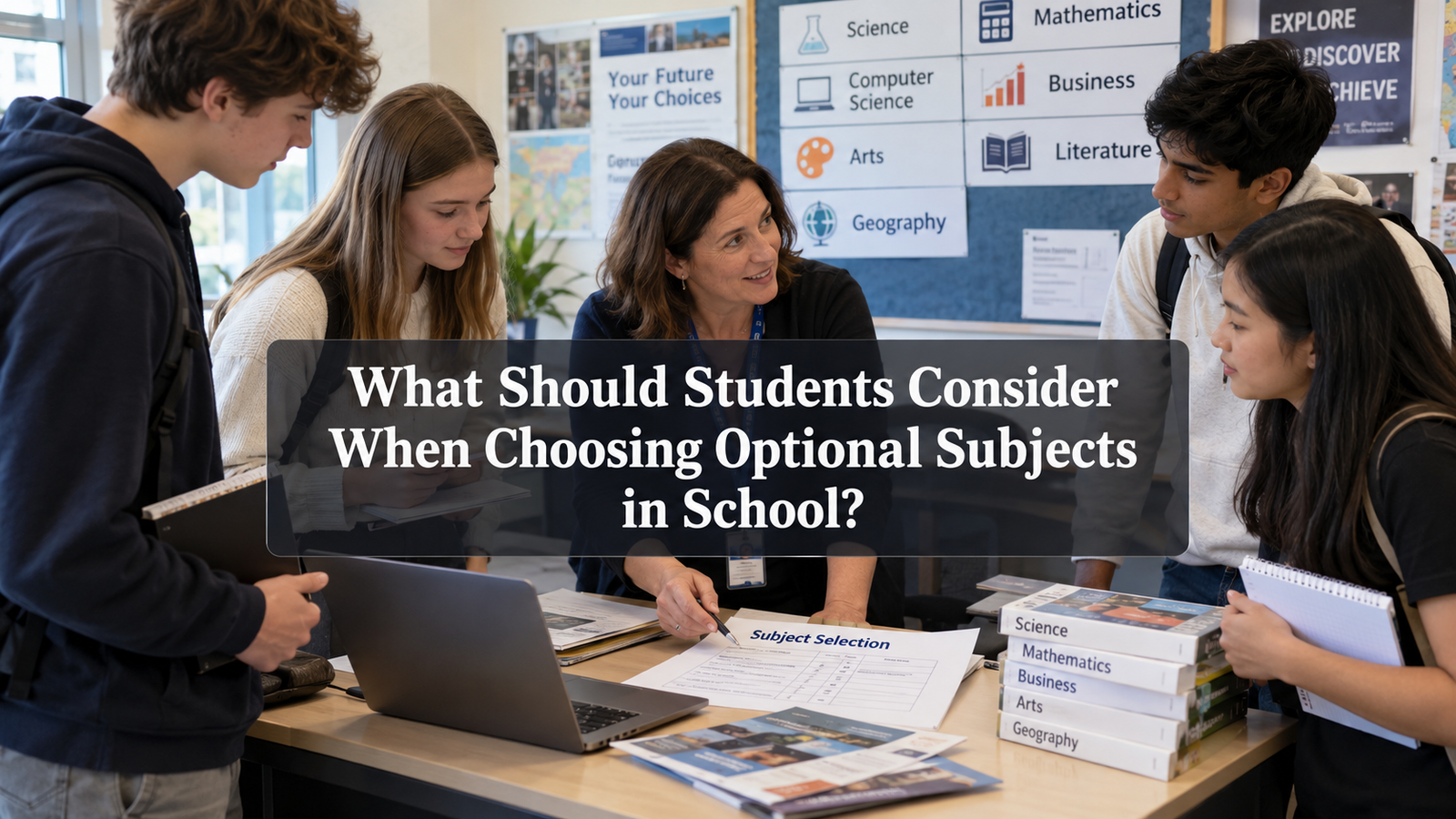
Choosing optional subjects in school is an important decision that can influence a student’s academic progress, personal development, and future educational opportunities. Every student has different interests, abilities, and career goals. Therefore, selecting the right subjects requires careful thinking rather than simply following friends or choosing courses that appear easy.
Optional subjects allow students to explore specific areas of knowledge beyond their compulsory studies. Depending on the school and education system, students may have opportunities to study computer science, economics, geography, psychology, business studies, additional languages, or creative arts.
The process of choosing optional subjects in school should begin with understanding personal interests, academic strengths, and future plans. Students who select subjects that match their abilities are often more motivated to learn and participate in classroom activities.
This article explains the important factors students should consider before selecting optional subjects and how thoughtful decisions can support long term academic success.
1. Understand Your Personal Interests
One of the first things students should consider when choosing optional subjects is their personal interest in different areas of learning.
Students usually enjoy studying subjects that capture their attention. For example, someone interested in technology may prefer computer science, while a student who enjoys understanding human behavior may find psychology interesting.
Personal interest is important because it encourages curiosity and regular learning.
When students genuinely enjoy a subject, they are more likely to complete assignments, participate in discussions, and explore additional learning materials.
However, students should remember that enjoying a subject does not mean every topic will be easy. Every academic field includes challenging concepts that require patience and practice.
A useful approach is to review the topics included in each optional subject and identify which ones seem interesting.
Choosing subjects based on genuine curiosity can make the learning experience more satisfying.
2. Identify Your Academic Strengths
Another important factor in selecting optional subjects is understanding personal academic abilities.
Every student has particular strengths. Some perform well in mathematics and logical reasoning, while others demonstrate stronger abilities in writing, communication, creativity, or scientific observation.
Recognizing these strengths can help students make suitable academic choices.
For example, students who enjoy calculations and solving numerical problems may consider accounting, mathematics, or economics.
Similarly, students who have strong reading and writing skills may feel comfortable studying literature, history, or additional languages.
However, previous examination results should not be the only factor in making a decision.
A student who receives average marks in a subject may still improve significantly through consistent practice and proper guidance.
The goal is to select subjects that provide a reasonable balance between personal ability, academic interest, and opportunities for improvement.
3. Think About Future Career Goals
Future career interests can play an important role in choosing optional subjects in school.
Although students do not need to decide their entire career at an early age, having a general idea about future interests can be helpful.
For example, students interested in engineering or technology may benefit from subjects related to mathematics, physics, and computer science.
Those interested in business management may consider economics, business studies, or accounting.
Students who enjoy creative careers may prefer subjects involving art, design, media, or literature.
However, the relationship between school subjects and careers varies across educational systems.
Some university programs require particular subjects, while others accept students from different academic backgrounds.
Therefore, students should research admission requirements before finalizing their choices.
Selecting relevant subjects can provide useful background knowledge and help students prepare for future education.
4. Review the Subject Syllabus Carefully
Before choosing any optional subject, students should review its syllabus.
A subject’s name may sound interesting, but its actual content can be different from what students expect.
For example, computer science may include programming, problem solving, and theoretical concepts rather than simply learning how to use computers.
Similarly, economics may involve graphs, calculations, and analytical thinking in addition to discussing business and financial activities.
Students should examine the main topics, learning objectives, and examination requirements.
They can also ask teachers about the type of assignments and classroom activities involved.
Understanding the syllabus helps students develop realistic expectations.
It also reduces the possibility of selecting a subject based on incomplete information.
A careful review allows students to make decisions based on actual course content rather than assumptions.
5. Consider the Difficulty Level
The difficulty level of optional subjects is another factor worth considering.
Some subjects require extensive reading and memorization, while others involve calculations, practical activities, or regular problem solving.
Students should think about the type of learning they find comfortable and the amount of effort they can realistically invest.
However, choosing a subject only because it appears easy may not be a wise decision.
A supposedly easy subject can become difficult when students have little interest in its content.
On the other hand, a challenging subject can become manageable when students are motivated and receive appropriate support.
Students should evaluate difficulty according to their own abilities rather than depending entirely on other people’s opinions.
The best choice is often a subject that encourages growth without creating unnecessary academic pressure.
6. Evaluate Your Study Schedule and Workload
Students should also consider their overall academic workload before selecting optional subjects.
Compulsory subjects already require time for homework, revision, tests, and examinations.
Adding an optional subject with demanding assignments may increase daily study responsibilities.
For example, a subject involving practical experiments, extensive reading, or regular projects may require additional preparation outside school hours.
Students who participate in sports, family responsibilities, or extracurricular activities should consider how these commitments fit into their schedules.
A realistic study plan can help maintain balance.
Choosing optional subjects that match available study time allows students to complete their responsibilities more effectively.
Good academic planning is not about avoiding hard work. It is about understanding how much work can be managed consistently.
7. Ask Teachers for Academic Guidance
Teachers can provide valuable advice when students are uncertain about their optional subject choices.
They understand course requirements, common learning difficulties, and the skills needed for different subjects.
Students can discuss their academic performance, interests, and future goals with teachers.
For example, a mathematics teacher may explain whether a student has the foundation required for advanced mathematical topics.
A computer science teacher may describe the programming and logical thinking involved in the course.
This guidance can help students identify possible challenges before making a final decision.
However, students should use teachers’ advice as a source of information rather than allowing someone else to make the entire decision.
The final choice should reflect the student’s personal interests and academic needs.
8. Avoid Choosing Subjects Only Because Friends Choose Them
Friendship is an important part of school life, but it should not become the main reason for choosing optional subjects.
Students sometimes select particular courses because their close friends are studying them.
Although studying with friends can make classroom activities enjoyable, the same subject may not suit everyone.
One student may enjoy business studies, while another may have a stronger interest in biology or computer science.
Following friends without considering personal preferences can lead to frustration and reduced motivation.
Students should remember that academic choices are individual decisions.
They can maintain friendships while studying different subjects.
Choosing independently encourages responsibility and helps students develop confidence in their own judgment.
9. Research Future Educational Requirements
Students planning to attend college or university should investigate the academic requirements of their preferred programs.
Certain educational pathways require specific subjects during earlier stages of education.
For example, some science, engineering, and healthcare programs have particular mathematics or science requirements.
Students who overlook these requirements may discover later that they need additional qualifications.
A practical solution is to review official admission information from institutions that offer programs of interest.
Students should also consult school counselors or academic advisers when possible.
This research is especially important when choosing between subject combinations that may affect future eligibility.
Even students who are uncertain about their careers can identify subjects that preserve several possible educational pathways.
Keeping suitable options available can provide greater flexibility in later years.
10. Consider the Availability of Learning Resources
Learning resources can influence how successfully students understand optional subjects.
Before making a decision, students should consider whether their school provides suitable textbooks, qualified teachers, practical facilities, and other educational support.
Some subjects may require computer laboratories, scientific equipment, art materials, or specialized learning resources.
Access to these facilities can improve the learning experience.
Students may also benefit from libraries, educational websites, recorded lectures, and practice materials.
However, online resources should supplement proper classroom instruction rather than replace it entirely.
When learning resources are limited, students should discuss available alternatives with teachers.
Understanding the support offered by the school helps students make practical academic decisions.
11. Understand the Examination and Assessment Methods
Different optional subjects may use different assessment methods.
Some rely heavily on written examinations, while others include practical work, presentations, projects, or coursework.
Students should understand these requirements before selecting a course.
For example, a student who enjoys practical activities may appreciate a subject that includes experiments or creative assignments.
Another student may feel more confident in courses that emphasize written explanations and structured examinations.
Students should not choose subjects simply to avoid an unfamiliar assessment method.
Instead, they should consider whether they are willing to develop the skills required.
Learning to manage different types of assessments can strengthen academic confidence and prepare students for future educational challenges.
12. Avoid Making Decisions Based Only on High Marks
Examination performance is important, but students should not select optional subjects solely because they believe those subjects produce higher marks.
A subject that appears suitable for scoring well may not match a student’s interests or abilities.
Similarly, a demanding subject may offer valuable knowledge and skills that support future studies.
Students should compare their personal strengths, the course content, and the assessment requirements.
It is also important to understand that examination results depend on preparation, understanding, and consistent effort.
No optional subject automatically guarantees excellent marks.
A balanced decision considers both academic performance and meaningful learning.
13. Consider Opportunities to Develop Useful Skills
Optional subjects can help students develop skills that extend beyond school examinations.
For example, computer science may strengthen logical thinking and digital literacy.
Economics can introduce students to decision making and resource management.
Literature may improve reading comprehension, writing, and communication skills.
Art and design can encourage creativity, observation, and visual expression.
These abilities can be useful in different educational and professional settings.
Students should think about the knowledge and practical skills they hope to gain from each subject.
Choosing courses that develop transferable skills can provide benefits even when future career plans change.
14. Discuss Your Choices With Parents and Guardians
Parents and guardians can offer useful support during academic decision making.
They may help students consider practical matters such as educational expenses, available learning resources, and future opportunities.
Discussing subject choices can also help families understand a student’s interests and ambitions.
However, students should communicate their preferences clearly rather than selecting subjects only to satisfy family expectations.
A respectful discussion allows everyone to consider different viewpoints.
Parents can provide encouragement while students take responsibility for their learning decisions.
The most helpful approach is cooperation based on realistic information and mutual understanding.
15. Keep Your Future Options Flexible
Not every student knows which career they want to pursue.
This uncertainty is normal because interests and abilities can develop with experience.
Students who are unsure about future plans should consider optional subjects that support multiple educational possibilities.
For example, subjects involving mathematics, communication, technology, or analytical thinking may develop skills useful in several fields.
However, students must also check whether particular courses are required for specific future programs.
Flexibility does not mean selecting subjects randomly.
It means choosing a combination that matches current interests while keeping realistic future opportunities available.
As students gain more experience, they can make increasingly informed educational decisions.
Common Mistakes Students Should Avoid
When choosing optional subjects in school, students sometimes make decisions without gathering enough information.
Common mistakes include selecting subjects because friends recommend them, assuming a course is easy, ignoring university admission requirements, and overlooking the amount of study time needed.
Another mistake is judging personal ability only through one examination result.
A single test does not always represent a student’s complete learning potential.
Students should also avoid believing that one particular optional subject guarantees career success.
Academic development depends on many factors, including practical skills, continued education, personal effort, and changing opportunities.
Avoiding these mistakes can help students make more confident and realistic choices.
How Can Students Make the Final Decision?
After reviewing the available options, students should compare subjects according to their interests, academic strengths, course requirements, and future goals.
They can begin by identifying the subjects they genuinely enjoy.
Next, they should examine the syllabus and discuss difficult topics with teachers.
Students can then compare expected workloads and investigate future educational requirements.
Finally, they should consider whether they have the time, resources, and motivation needed to study each subject successfully.
This process encourages thoughtful decision making.
Students should also confirm their school’s rules about subject combinations and whether changes are permitted after enrollment.
Understanding these policies helps prevent avoidable difficulties.
Frequently Asked Questions
How should students choose optional subjects in school?
Students should consider their interests, academic strengths, future educational plans, subject syllabuses, and available learning resources. Advice from teachers and academic counselors can also help.
Should students choose easy optional subjects?
Students should not select subjects based only on perceived difficulty. A suitable subject should match their abilities, interests, and willingness to study consistently.
Can optional subjects affect university admission?
Yes, some university programs require specific school subjects. Students should check official admission requirements before making decisions that could affect future eligibility.
Is it better to choose subjects based on interest or career goals?
Both factors matter. Students should look for subjects that interest them while considering whether those subjects support their future educational opportunities.
Can students change optional subjects later?
This depends on the school’s policies, timetable, and enrollment deadlines. Students should confirm the relevant rules before finalizing their subject choices.
Conclusion
Choosing optional subjects in school is an important step in developing a student’s educational direction. The right decision requires more than selecting popular courses or following friends.
Students should examine their personal interests, academic strengths, future career possibilities, subject content, examination methods, and available study time.
They should also seek reliable guidance from teachers, communicate with parents, and research future educational requirements.
Most importantly, students should understand that optional subjects provide opportunities for learning, discovering interests, and developing useful abilities.
A thoughtful subject choice can increase motivation, support academic progress, and help students prepare for future challenges.
By considering these factors carefully, students can select optional subjects with greater confidence and build a stronger foundation for their continuing education.